Open this record in the complete research map
Pengaruh Suhu Pembiusan terhadap Kelangsungan Hidup Udang Red Cherry (Neocaridina denticulata sinensis) selama Transportasi Sistem Kering Suhu Rendah
Ismandar, Dewantoro and Rachimi, 2020. Borneo Akuatika 2(1): 1-7.
This record is a claim boundary, not a quality badge. Evidence class and species relationship describe what was studied. They do not make the result universal, complete or automatically applicable to a home aquarium.
- Source taxon as published
- Neocaridina denticulata sinensis
- Environment
- Low-temperature dry transport in a 30 by 30 by 40 cm insulated box layered with ice, Imperata grass, shrimp, grass and ice after gradual cooling; the package was intended to remain at 17 C
- Life stages
- 1 to 2 cm shrimp
- Reviewed
- 2026-08-12
What was studied
Study shape: Four target-water cooling treatments of 13, 15, 17 and 19 C were compared with three replicate groups per treatment. The report says temperature was lowered gradually to the target over or for 10 minutes, animals were packed without water at a nominal 17 C package temperature, and the insulated box traveled for 24 hours in a closed vehicle.
Experimental unit: Replicate transport group within a temperature treatment. The methods report 120 shrimp total, four treatments, three replicates and parenthetically 10 shrimp per treatment; those figures are compatible only if 10 means per replicate, so the written animal-unit description is internally inconsistent.
Endpoints: survival immediately after 24-hour transport, time from normal behaviour to reported immobility, time from reported immobility to movement or consciousness response, cooling behaviour, group mean weight change.
Claim boundary
What it can support: The results table reports immediate post-transport survival of 86.67 +/- 5.77, 76.67 +/- 11.55, 50.00 +/- 10.00 and 33.33 +/- 5.77 percent for the 13, 15, 17 and 19 C target groups. The same groups had reported induction times of 203, 341, 431 and 530 seconds and reported recovery-response times of 3, 5, 28 and 33 minutes. Survival at 13 and 15 C was not statistically different in the article.
What it cannot support: This atypical dry chilled protocol is not a conventional or gas-permeable water bag and does not validate home cooling or anesthesia. The abstract mislabels treatment B as 13 C while giving the 15 C result, the results table gives higher survival and lower weight change at 13 C, and the conclusion calls 15 C best without resolving that conflict. The text also reports panic-like behaviour at 15 to 17 C while the conclusion says gradual cooling avoided a panic phase. The cooling wording does not distinguish ramp duration from a target-temperature hold, grass moisture and conditioning were not specified, and no package-temperature trace, detailed checks, recovery-water method, recovery denominator or delayed survival was reported. The weight-change formula uses grams while the table uses milligrams, the abstract reports 0.1 mg while the body reports 0.01 mg for 13 C, and recovery time was not included in the stated ANOVA plan even though the conclusion calls it significantly affected. Loss of balance, weak response and immobility were experimental endpoints, not normal receiving signs or permission to reproduce the protocol.
Publication status audit
Canonical DOI outside query result
The record has a canonical DOI but did not appear in the broad Neocaridina query. It requires DOI-specific or alternative-registry status review before any no-update statement.
Metadata snapshot reviewed 2026-08-12. Inspect the method, unmatched queue and limitations.
Correction impact
If this source boundary changes, these are the known downstream consumers. The list distinguishes scientific re-review from generated parity and historical follow-up.
Editorial review required (9)
This curated wording or synthesis must be reconsidered when the source boundary changes. A passing generator test cannot decide the new scientific meaning.
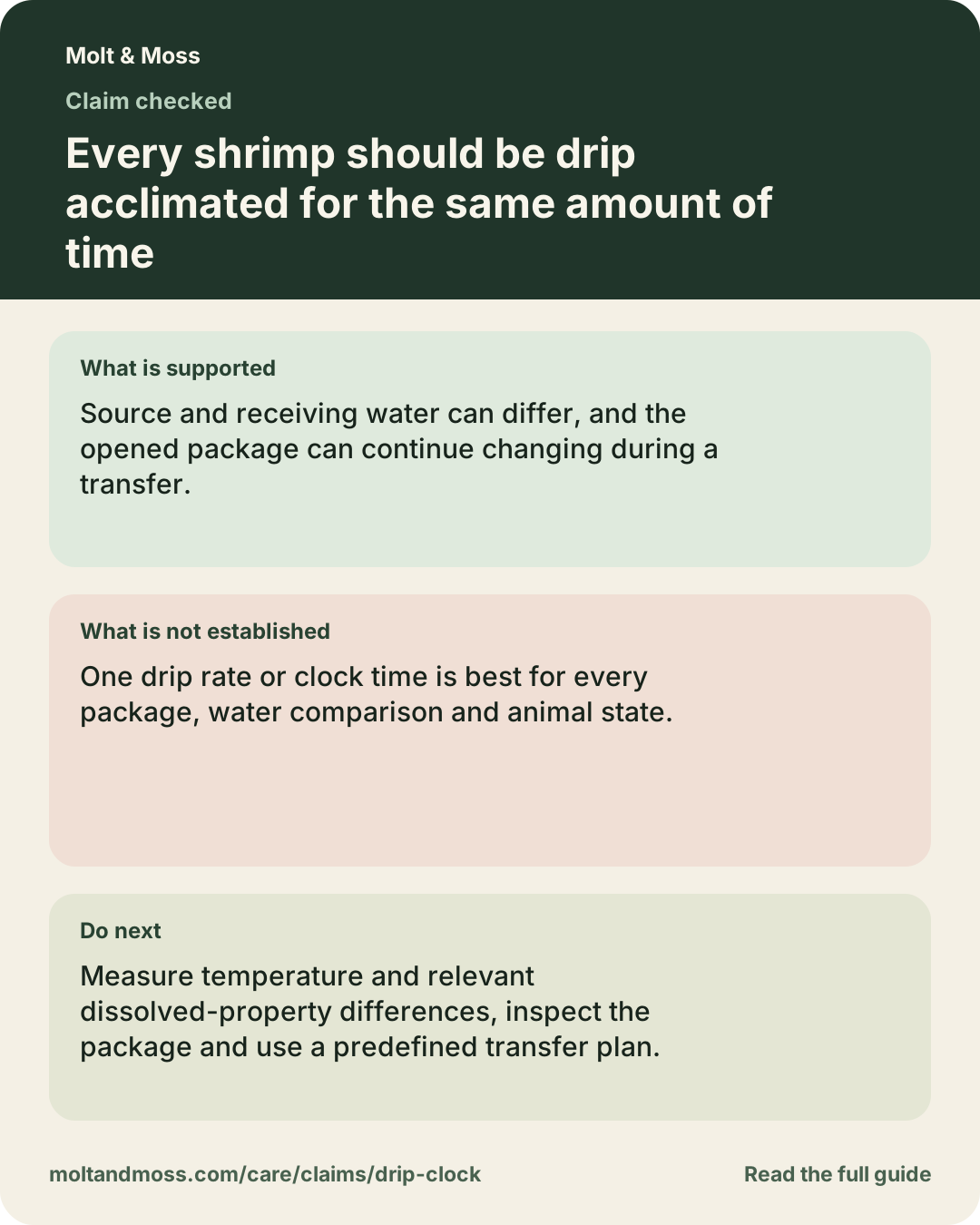
- Every shrimp should be drip acclimated for the same amount of time Curated claim check
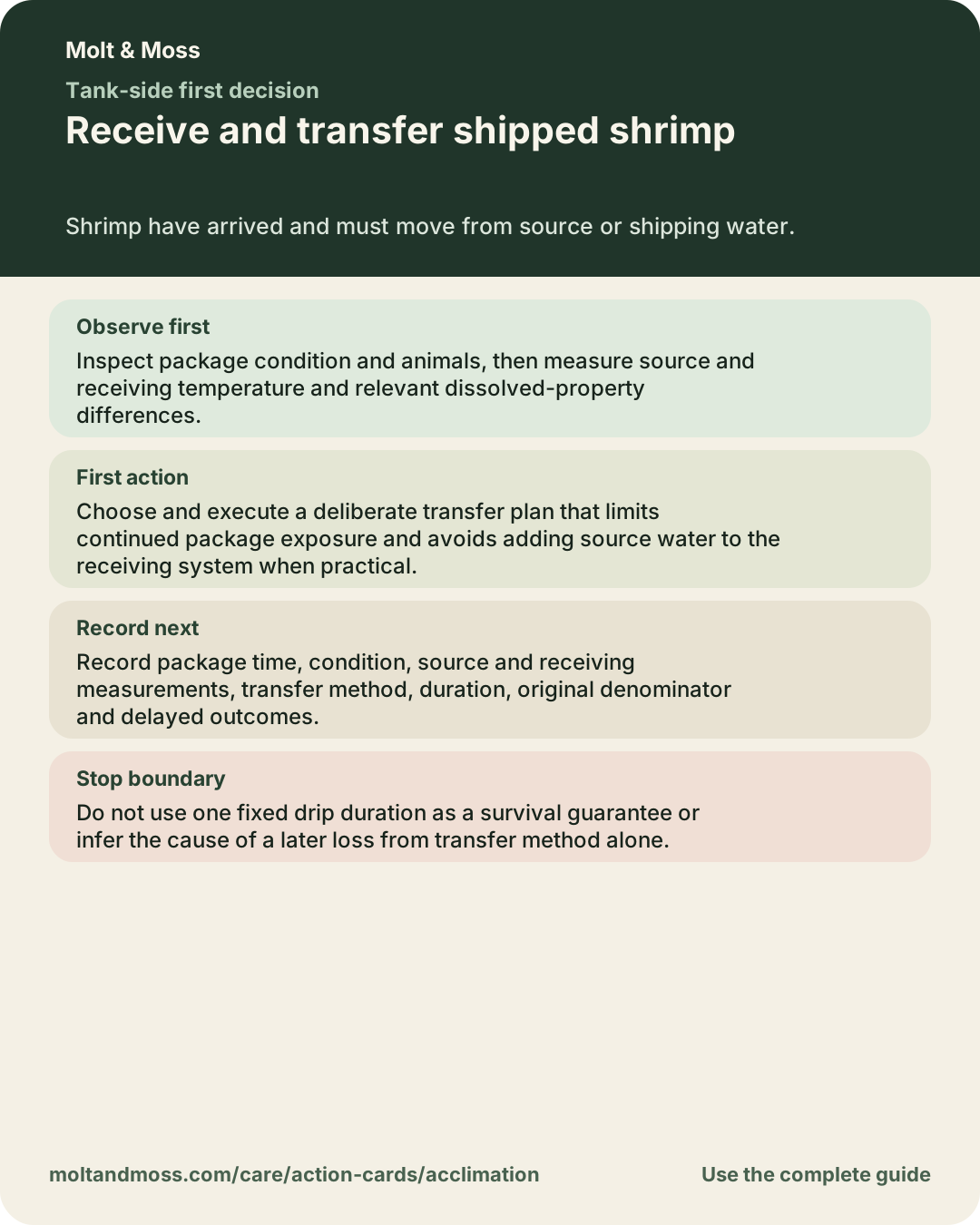
The exact claim trace uses this record as limitation context: An atypical dry chilled protocol cannot establish routine wet-bag acclimation timing. - acclimation decision card Tank-side decision card
The card translates this guide into an observation, first action, next record and stopping boundary, so all four require editorial review when the source changes. - acclimation practical guide Practical guide
The guide uses this evidence record and its practical wording must remain inside the revised source boundary. - shipping-package-limits knowledge gap Canonical knowledge gap
The current knowledge-gap boundary depends on a dated search that used this exact source and must be reconsidered if the source meaning changes. - transfer-rate knowledge gap Canonical knowledge gap
The current knowledge-gap boundary depends on a dated search that used this exact source and must be reconsidered if the source meaning changes. - shipping-package-limits answerability brief Answerability brief
The decision, endpoint, minimum design or closure rule may change when evidence used in the linked gap search is corrected. - transfer-rate answerability brief Answerability brief
The decision, endpoint, minimum design or closure rule may change when evidence used in the linked gap search is corrected. - shipping-package-limits research allocation Current research allocation
The current allocation, activation trigger, next permitted unit or stop decision may change when evidence used in the linked gap search is corrected. - transfer-rate research allocation Current research allocation
The current allocation, activation trigger, next permitted unit or stop decision may change when evidence used in the linked gap search is corrected.
Generated from governing registry (13)
This surface derives from a governing registry and should update with it, but release tests must still prove parity and routing.
- Record CSL-JSON citation Citation export
The record citation export derives its note and source metadata from the evidence registry. - Record RIS citation Citation export
The record citation export derives its note and source metadata from the evidence registry. - Complete CSL-JSON bibliography Citation export
The complete citation export includes every evidence registry record. - Complete RIS bibliography Citation export
The complete citation export includes every evidence registry record. - acclimation teaching card Generated claim teaching card
The teaching card is generated from the curated claim wording. - acclimation portable reply Generated claim text
The portable reply is generated from the curated claim wording. - acclimation portable decision card Generated decision-card text
The portable text derives from the curated decision-card registry and must preserve every card section and both permanent links. - acclimation complete visual decision card Generated decision-card visual
The typography-only visual and exact accessibility description derive from the curated decision-card registry and must preserve every card section. - Pengaruh Suhu Pembiusan terhadap Kelangsungan Hidup Udang Red Cherry (Neocaridina denticulata sinensis) selama Transportasi Sistem Kering Suhu Rendah Canonical evidence page
The canonical evidence page derives from the current evidence registry record. - acclimation evidence dossier Generated guide dossier
The dossier derives its linked evidence set from the record care path. - acclimation review item Generated independent-review item
The independent-review item derives from the exact claim trace and publication-status registry. - Machine-readable knowledge export Machine-readable knowledge export
The versioned export includes the complete evidence registry and source-integrity audit. - Research map record Research map
The research map derives its source boundary from the evidence registry.
Historical record needs follow-up decision (2)
Do not silently rewrite history. Decide whether the prior change record remains accurate and publish a new correction or scope note when needed.
- Do direct transport studies validate a package combination or an acclimation rate for Neocaridina? Dated literature search
The dated search used this exact source as a candidate (included: Pengaruh Suhu Pembiusan terhadap Kelangsungan Hidup Udang Red Cherry (Neocaridina denticulata sinensis) selama Transportasi Sistem Kering Suhu Rendah). Preserve the search history and decide whether a revised or additional search is required. - Cold-induced immobility is not a home shipping tip Historical research change
The historical change cites this source. Preserve the old decision and decide whether a new public correction is required.
How this record is classified
Controlled experiment: An assigned treatment or controlled comparison. The treatment, unit, duration and endpoint still limit the claim.
Direct Neocaridina evidence: The source measured animals named within Neocaridina. Direct still does not mean universal or sufficient.
Topics: Transport and acclimation, Temperature, Health
Critically appraise this source without a score
These questions fit this record's controlled experiment role. They are prompts, not automatic judgments. Open the original source to answer them.
- Identity and provenance: How were the organism, population, stock and life stage identified and sourced? A published name or seller label can hide a taxonomic, population or life-stage transfer.
- Independent unit: What unit was independently assigned or sampled, and how many units support each comparison? Animal counts do not create independent replication when animals share a vessel, site, family or treatment history.
- Comparison and context: What was the actual comparator, allocation process, environment, duration and material condition? A result has meaning only against the comparison and conditions that produced it.
- Endpoint and measurement: Which endpoint was measured, with what method, unit, timing, resolution and decision rule? One endpoint cannot silently become survival, welfare, diagnosis, reproduction or long-term population performance.
- Denominators and missingness: Are starting counts, exclusions, losses, missing observations and analysis denominators reconciled? Unreported or changing denominators can alter the apparent direction, precision and applicability of a result.
- Transfer boundary: What is the nearest tempting aquarium claim that this source design cannot establish? Direct evidence can still be narrow, and adjacent evidence can be useful only while the inference remains visible.
- Treatment assignment: Were independent units assigned to treatments, and were baseline conditions comparable? Unclear allocation or baseline imbalance can confound the treatment comparison.
- Replication: Were treatment vessels or other exposure units independently replicated rather than subsampled? Repeated animals or assays inside one exposure unit do not replicate the environmental treatment.
- Exposure verification: Was the treatment, dose, feed intake or environmental exposure measured and maintained as described? Nominal treatment labels may not equal the exposure animals actually received.
- Analysis: Did the statistical model match the unit, repeated measures, multiplicity and missing outcomes? A precise p-value cannot repair a mismatched unit or unaccounted comparison structure.
Where it is used
Reuse the reviewed citation boundary
Download CSL-JSON or download RIS. Both retain this record's support, limitation and review note.
Challenge a transcription, interpretation or missing boundary. A challenge changes the record only after editorial review.