Open this record in the complete research map
Reproductive Biology of Neocaridina denticulata denticulata and Latreutes planirostris
Jeong, Oh and Ma, 2006. Korean Journal of Fisheries and Aquatic Sciences 39(Special Issue): 198-202.
This record is a claim boundary, not a quality badge. Evidence class and species relationship describe what was studied. They do not make the result universal, complete or automatically applicable to a home aquarium.
- Source taxon as published
- Wild Neocaridina denticulata denticulata collected around Wolchulsan in Yeongam County, Korea
- Environment
- One Korean valley-stream population collected by scoop net during 2001, fixed in 5 percent neutral formalin and analyzed in the laboratory
- Life stages
- field-collected ovigerous female, non-eyed embryo, eyed embryo, ovary
- Reviewed
- 2026-08-12
What was studied
Study shape: Only ovigerous field females were selected for brood analysis. Carapace length was measured to 0.01 mm, every attached egg was counted and classified as non-eyed or eyed, five eggs per female were sampled for long- and short-axis volume estimates, and females plus eggs were dried for 48 hours at 80 C for reproductive-output calculations. Separate monthly groups of 48 to 60 females supplied gonadosomatic-index measurements.
Experimental unit: The individual selected ovigerous female for brood, egg-volume and reproductive-output results; the monthly female sample for the cross-sectional gonadosomatic series. Table 1 reports 43 Neocaridina females, while Table 2 reports 35 non-eyed-stage and 48 eyed-stage females.
Endpoints: carapace length, attached egg count, egg volume, female and egg dry weight, reproductive output, monthly gonadosomatic index, ovarian dry weight by embryo stage.
Claim boundary
What it can support: Among 43 selected ovigerous females measuring 5.69 to 7.85 mm carapace length, broods ranged from 47 to 117 eggs with a reported mean of 82 +/- 18. Mean sampled egg volume was 0.70 mm3, and reported reproductive output averaged 41.84 percent. Monthly gonadosomatic index was 3.8 to 4.3 from January through March, peaked at 27.5 in May, remained above 10 through July and declined from August. At a common carapace-length slope, ovarian dry weight was higher in females carrying eyed rather than non-eyed eggs, supporting ovarian rematuration during embryo development in this field sample.
What it cannot support: The published taxon is N. denticulata denticulata from one wild Korean population, not captive N. davidi or a selected aquarium line. The article does not report a taxonomic key or voucher, exact collection dates, effort, water temperature, chemistry, food, female source denominator or annual replication. Selection of ovigerous females prevents estimating prevalence, mating success or population fecundity. Preservation and destructive cross-sectional sampling mean individual females were not followed through hatch or a second brood; ovarian rematuration supports only the potential for consecutive spawning. Egg fertilization, retention, hatch, juvenile survival and brood loss were not measured. The monthly field pattern is not a temperature treatment, aquarium breeding calendar, clutch forecast or care target.
Publication status audit
Matched in dated Crossref query
The canonical DOI appeared in the dated broad query and carried no registered update in that response. This is a metadata observation, not proof that the work has never changed.
Metadata snapshot reviewed 2026-08-12. Inspect the method, unmatched queue and limitations.
Correction impact
If this source boundary changes, these are the known downstream consumers. The list distinguishes scientific re-review from generated parity and historical follow-up.
Editorial review required (4)
This curated wording or synthesis must be reconsidered when the source boundary changes. A passing generator test cannot decide the new scientific meaning.
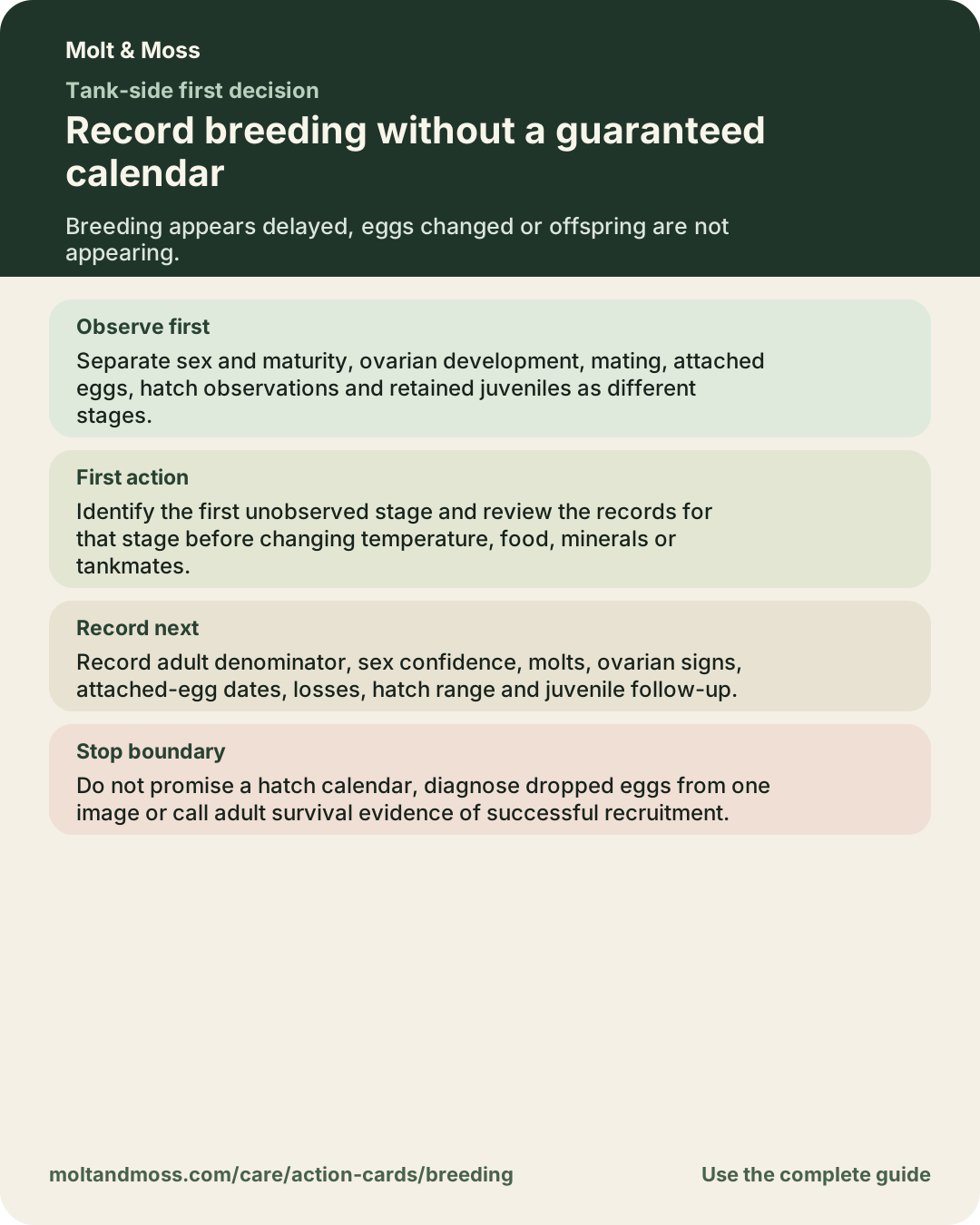
- breeding decision card Tank-side decision card
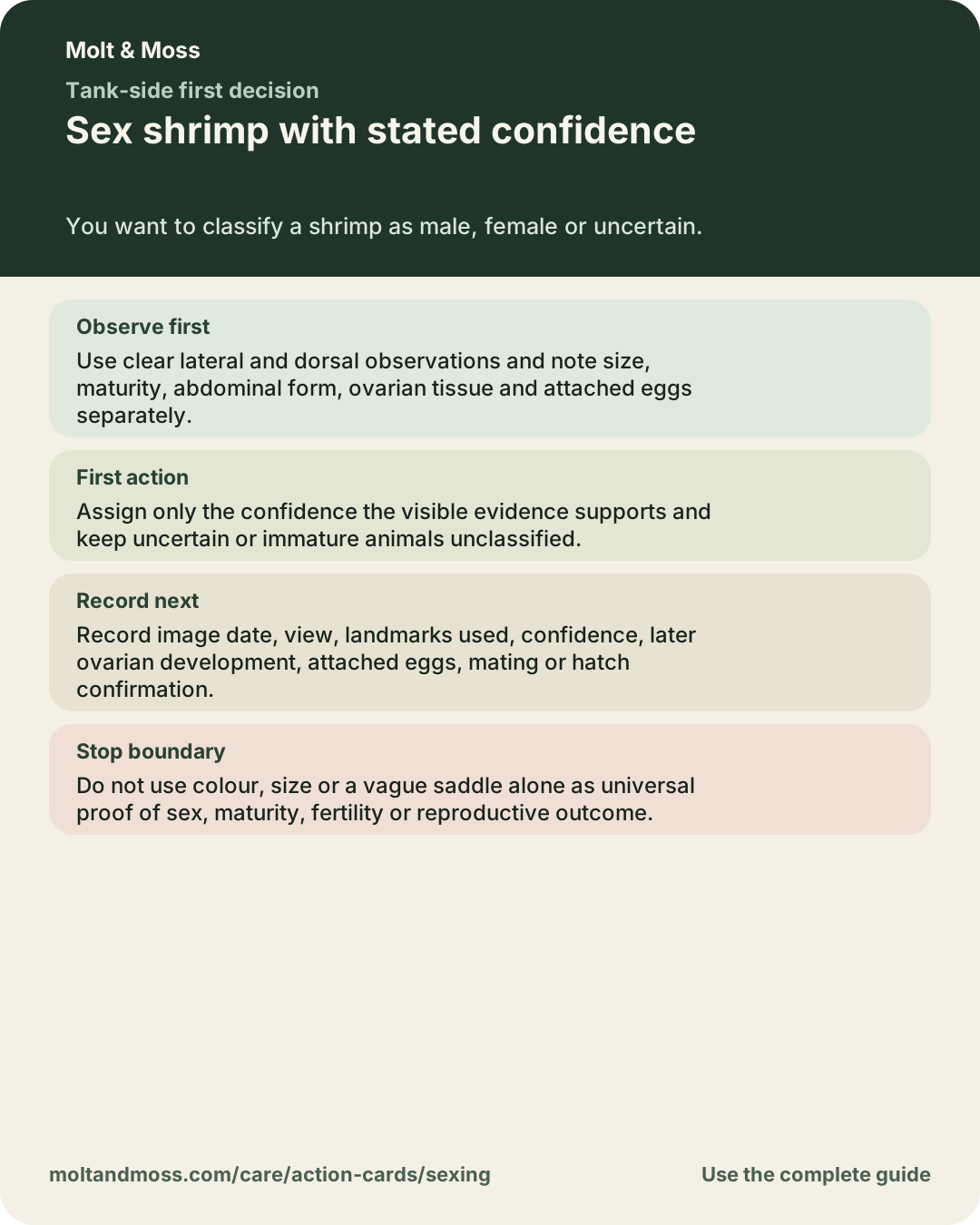
The card translates this guide into an observation, first action, next record and stopping boundary, so all four require editorial review when the source changes. - sexing decision card Tank-side decision card
The card translates this guide into an observation, first action, next record and stopping boundary, so all four require editorial review when the source changes. - breeding practical guide Practical guide
The guide uses this evidence record and its practical wording must remain inside the revised source boundary. - sexing practical guide Practical guide
The guide uses this evidence record and its practical wording must remain inside the revised source boundary.
Generated from governing registry (13)
This surface derives from a governing registry and should update with it, but release tests must still prove parity and routing.
- Record CSL-JSON citation Citation export
The record citation export derives its note and source metadata from the evidence registry. - Record RIS citation Citation export
The record citation export derives its note and source metadata from the evidence registry. - Complete CSL-JSON bibliography Citation export
The complete citation export includes every evidence registry record. - Complete RIS bibliography Citation export
The complete citation export includes every evidence registry record. - breeding portable decision card Generated decision-card text
The portable text derives from the curated decision-card registry and must preserve every card section and both permanent links. - sexing portable decision card Generated decision-card text
The portable text derives from the curated decision-card registry and must preserve every card section and both permanent links. - breeding complete visual decision card Generated decision-card visual
The typography-only visual and exact accessibility description derive from the curated decision-card registry and must preserve every card section. - sexing complete visual decision card Generated decision-card visual
The typography-only visual and exact accessibility description derive from the curated decision-card registry and must preserve every card section. - Reproductive Biology of Neocaridina denticulata denticulata and Latreutes planirostris Canonical evidence page
The canonical evidence page derives from the current evidence registry record. - breeding evidence dossier Generated guide dossier
The dossier derives its linked evidence set from the record care path. - sexing evidence dossier Generated guide dossier
The dossier derives its linked evidence set from the record care path. - Machine-readable knowledge export Machine-readable knowledge export
The versioned export includes the complete evidence registry and source-integrity audit. - Research map record Research map
The research map derives its source boundary from the evidence registry.
Historical record needs follow-up decision (1)
Do not silently rewrite history. Decide whether the prior change record remains accurate and publish a new correction or scope note when needed.
- A selected wild brood count is not a colony forecast Historical research change
The historical change cites this source. Preserve the old decision and decide whether a new public correction is required.
How this record is classified
Field observation: Animals were observed in a field population. Occurrence and association do not create a home-aquarium optimum or prove causation.
Direct Neocaridina evidence: The source measured animals named within Neocaridina. Direct still does not mean universal or sufficient.
Topics: Breeding, Anatomy, Wild populations
Critically appraise this source without a score
These questions fit this record's field observation role. They are prompts, not automatic judgments. Open the original source to answer them.
- Identity and provenance: How were the organism, population, stock and life stage identified and sourced? A published name or seller label can hide a taxonomic, population or life-stage transfer.
- Independent unit: What unit was independently assigned or sampled, and how many units support each comparison? Animal counts do not create independent replication when animals share a vessel, site, family or treatment history.
- Comparison and context: What was the actual comparator, allocation process, environment, duration and material condition? A result has meaning only against the comparison and conditions that produced it.
- Endpoint and measurement: Which endpoint was measured, with what method, unit, timing, resolution and decision rule? One endpoint cannot silently become survival, welfare, diagnosis, reproduction or long-term population performance.
- Denominators and missingness: Are starting counts, exclusions, losses, missing observations and analysis denominators reconciled? Unreported or changing denominators can alter the apparent direction, precision and applicability of a result.
- Transfer boundary: What is the nearest tempting aquarium claim that this source design cannot establish? Direct evidence can still be narrow, and adjacent evidence can be useful only while the inference remains visible.
- Sampling frame: How were sites, dates, habitats and animals selected, and what population can that sampling represent? Convenient or uneven sampling limits prevalence, abundance and seasonal inference.
- Sampling effort: Was effort standardized or recorded across sites, times and environmental conditions? Observed counts can change because detectability or effort changed rather than the population.
- Association: Which co-varying environmental or biological factors could explain the observed association? Field correlation does not by itself identify cause or a husbandry intervention.
- Detection and absence: Could non-detection reflect gear, visibility, season, behavior or identification limits? Not observed is not equivalent to absent.
Where it is used
Reuse the reviewed citation boundary
Download CSL-JSON or download RIS. Both retain this record's support, limitation and review note.
Challenge a transcription, interpretation or missing boundary. A challenge changes the record only after editorial review.