Open this record in the complete research map
Identification of putative ecdysteroid and juvenile hormone pathway genes in the shrimp Neocaridina denticulata
Sin et al., 2015. General and Comparative Endocrinology 214: 167-176.
This record is a claim boundary, not a quality badge. Evidence class and species relationship describe what was studied. They do not make the result universal, complete or automatically applicable to a home aquarium.
- Source taxon as published
- Neocaridina denticulata linked to the Kenny et al. draft-genome stock; the RNA-source animals were not otherwise identified or described
- Environment
- Computational analysis of the 2014 short-read draft genome plus laboratory RT-PCR and Sanger sequencing from RNA isolated from several animals at different life stages; animal holding conditions were not reported in this article
- Life stages
- embryo RNA sample, juvenile anterior and posterior RNA samples, adult head and posterior RNA samples
- Reviewed
- 2026-08-12
What was studied
Study shape: Known arthropod hormone-pathway sequences were searched against the draft genome with TBLASTN and checked by reciprocal BLASTX, characteristic domains and, where identity was uncertain, Bayesian phylogenetic analysis. Selected partial transcripts were amplified from cDNA, cloned and Sanger sequenced. A semiquantitative JHAMT gel used equivalent total-RNA inputs and displayed three individual samples for each reported life-stage or body-region group.
Experimental unit: Gene sequence and draft-genome contig for homology analyses. For the JHAMT expression gel, the caption reports three independent individual shrimp samples per life-stage or body-region group, while the methods describe RNA from several individuals without source, sex, exact age, molt stage or allocation details.
Endpoints: reciprocal sequence homology, diagnostic protein domains, Bayesian phylogenetic placement, cloned partial cDNA sequence, GenBank accessions KJ200310-KJ200321, KJ579126-KJ579131 and KJ956470-KJ956473, semiquantitative JHAMT RT-PCR band presence across life-stage and body-region samples.
Claim boundary
What it can support: The study catalogued candidate orthologues for sesquiterpenoid biosynthesis, binding and degradation; ecdysteroid biosynthesis; and putative hormone regulation or signal transduction in the source draft genome. It validated selected partial transcripts and reported stronger JHAMT gel bands in embryos and juvenile anterior samples than in adult posterior samples under its assay.
What it cannot support: Candidate sequence homology and transcript detection do not demonstrate the encoded protein, enzyme activity, endogenous juvenile hormone, methyl farnesoate or ecdysteroid concentration, tissue-specific function or a causal role in molting or reproduction. Shade was not recovered, which the authors attributed as possibly due to poor recovery of that genomic locus. The JHAMT comparison was a semiquantitative endpoint using equal total-RNA inputs, not qPCR with a reported reference gene, band densitometry or statistical model. Animal source, taxon verification, culture system, sex, exact age, molt and reproductive stage were not reported; the draft genome came from one unvouchered commercial adult. Supplementary alignments, phylogenies and primer details were referenced but were not accessible in this review and were not independently reanalyzed. No live-animal hormone treatment, RNA interference, molt frequency, ecdysis success, growth, survival, fertility or offspring outcome was measured. The paper does not validate a hormone supplement, insect-growth-regulator treatment, mineral dose, breeding intervention, molt diagnosis, commercial-line marker or consumer genetic test.
Publication status audit
Matched in dated Crossref query
The canonical DOI appeared in the dated broad query and carried no registered update in that response. This is a metadata observation, not proof that the work has never changed.
Metadata snapshot reviewed 2026-08-12. Inspect the method, unmatched queue and limitations.
Correction impact
If this source boundary changes, these are the known downstream consumers. The list distinguishes scientific re-review from generated parity and historical follow-up.
Editorial review required (6)
This curated wording or synthesis must be reconsidered when the source boundary changes. A passing generator test cannot decide the new scientific meaning.
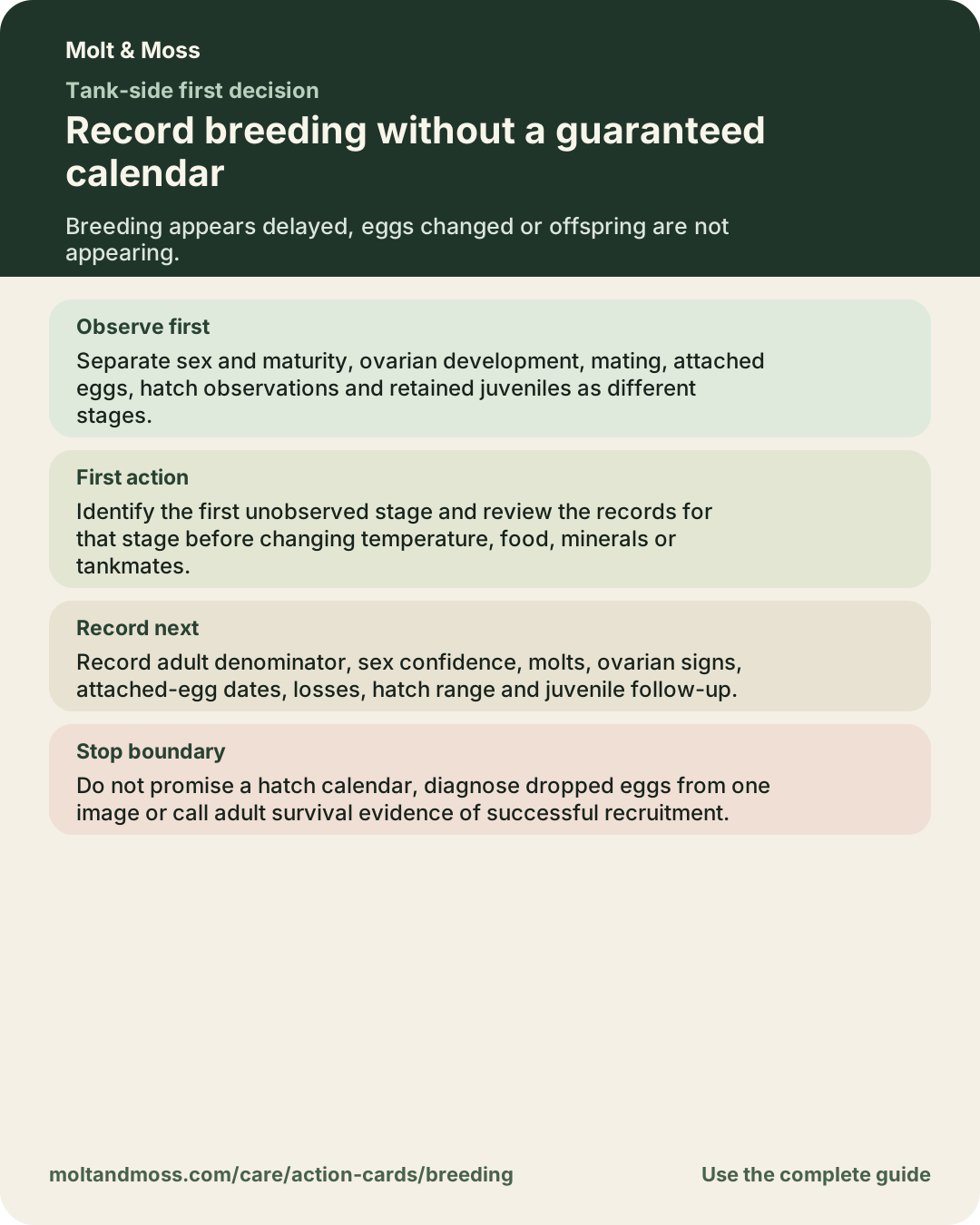
- breeding decision card Tank-side decision card
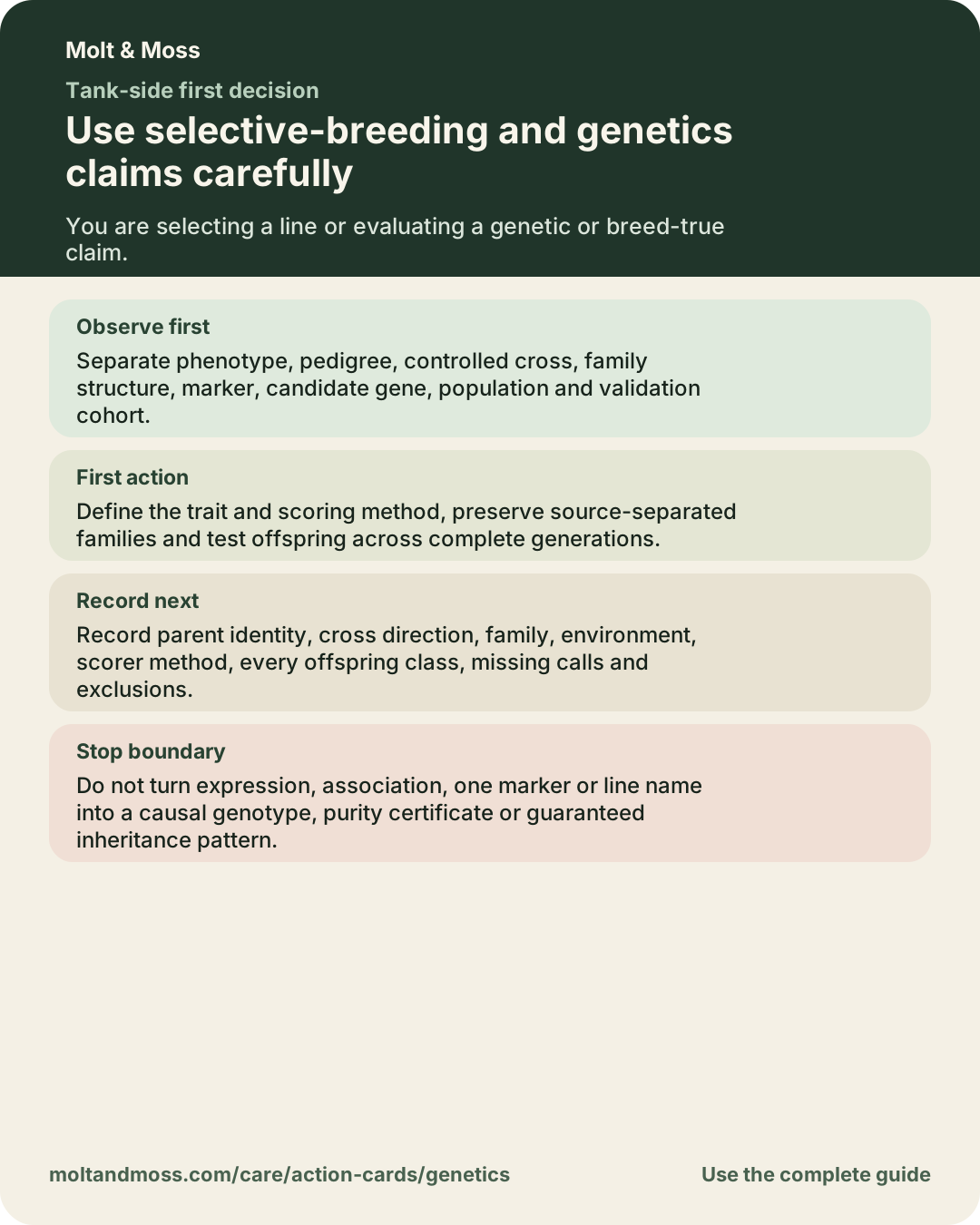
The card translates this guide into an observation, first action, next record and stopping boundary, so all four require editorial review when the source changes. - genetics decision card Tank-side decision card
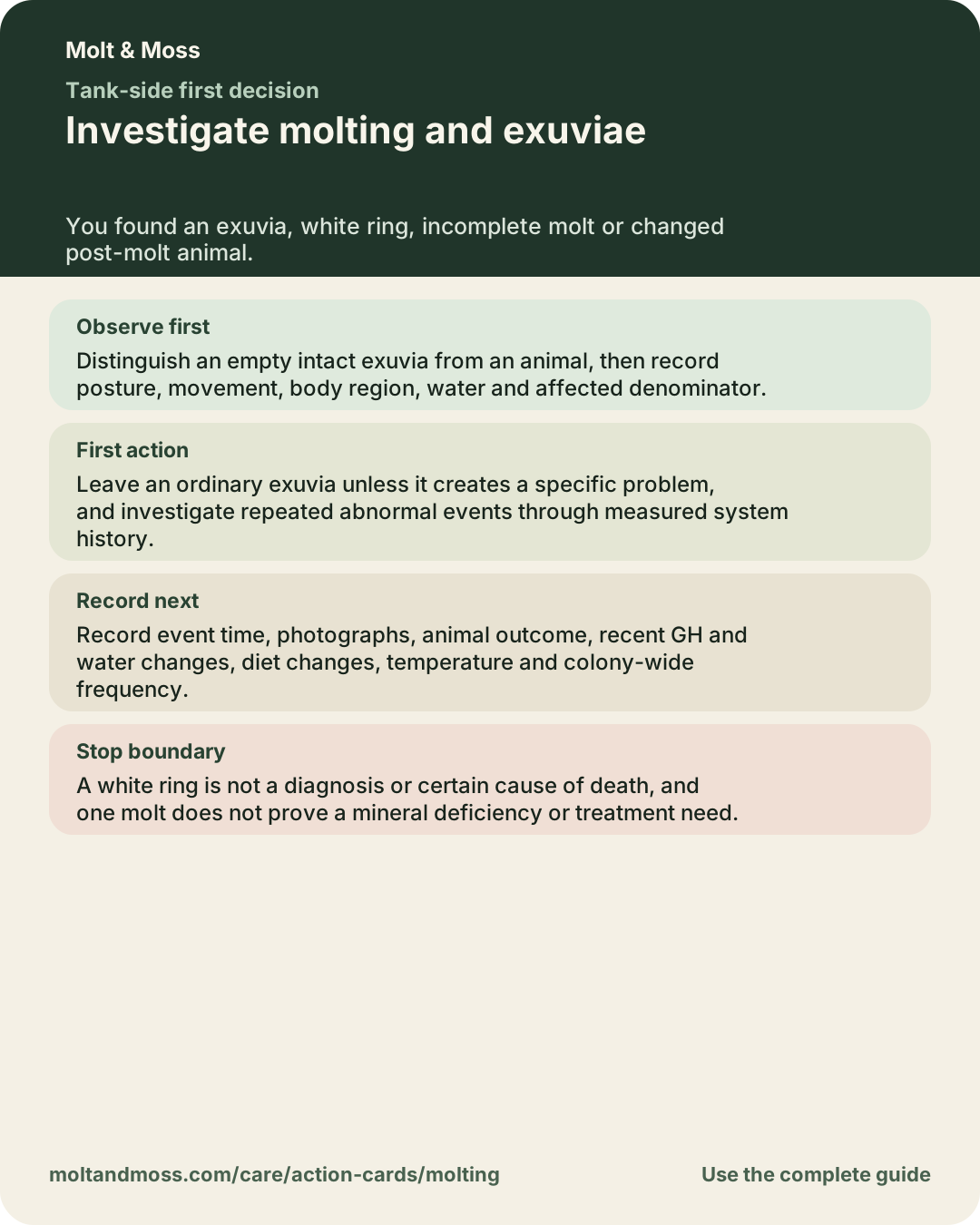
The card translates this guide into an observation, first action, next record and stopping boundary, so all four require editorial review when the source changes. - molting decision card Tank-side decision card
The card translates this guide into an observation, first action, next record and stopping boundary, so all four require editorial review when the source changes. - breeding practical guide Practical guide
The guide uses this evidence record and its practical wording must remain inside the revised source boundary. - genetics practical guide Practical guide
The guide uses this evidence record and its practical wording must remain inside the revised source boundary. - molting practical guide Practical guide
The guide uses this evidence record and its practical wording must remain inside the revised source boundary.
Generated from governing registry (16)
This surface derives from a governing registry and should update with it, but release tests must still prove parity and routing.
- Record CSL-JSON citation Citation export
The record citation export derives its note and source metadata from the evidence registry. - Record RIS citation Citation export
The record citation export derives its note and source metadata from the evidence registry. - Complete CSL-JSON bibliography Citation export
The complete citation export includes every evidence registry record. - Complete RIS bibliography Citation export
The complete citation export includes every evidence registry record. - breeding portable decision card Generated decision-card text
The portable text derives from the curated decision-card registry and must preserve every card section and both permanent links. - genetics portable decision card Generated decision-card text
The portable text derives from the curated decision-card registry and must preserve every card section and both permanent links. - molting portable decision card Generated decision-card text
The portable text derives from the curated decision-card registry and must preserve every card section and both permanent links. - breeding complete visual decision card Generated decision-card visual
The typography-only visual and exact accessibility description derive from the curated decision-card registry and must preserve every card section. - genetics complete visual decision card Generated decision-card visual
The typography-only visual and exact accessibility description derive from the curated decision-card registry and must preserve every card section. - molting complete visual decision card Generated decision-card visual
The typography-only visual and exact accessibility description derive from the curated decision-card registry and must preserve every card section. - Identification of putative ecdysteroid and juvenile hormone pathway genes in the shrimp Neocaridina denticulata Canonical evidence page
The canonical evidence page derives from the current evidence registry record. - breeding evidence dossier Generated guide dossier
The dossier derives its linked evidence set from the record care path. - genetics evidence dossier Generated guide dossier
The dossier derives its linked evidence set from the record care path. - molting evidence dossier Generated guide dossier
The dossier derives its linked evidence set from the record care path. - Machine-readable knowledge export Machine-readable knowledge export
The versioned export includes the complete evidence registry and source-integrity audit. - Research map record Research map
The research map derives its source boundary from the evidence registry.
Historical record needs follow-up decision (1)
Do not silently rewrite history. Decide whether the prior change record remains accurate and publish a new correction or scope note when needed.
- A hormone-pathway gene is not a molting treatment Historical research change
The historical change cites this source. Preserve the old decision and decide whether a new public correction is required.
How this record is classified
System observation or method study: An aquarium, analytical or biological system was observed without an assigned Neocaridina animal treatment. The species relationship still identifies whether the evidence is biological or system-adjacent.
Direct Neocaridina evidence: The source measured animals named within Neocaridina. Direct still does not mean universal or sufficient.
Topics: Genetics, Molting, Breeding
Critically appraise this source without a score
These questions fit this record's system observation or method study role. They are prompts, not automatic judgments. Open the original source to answer them.
- Identity and provenance: How were the organism, population, stock and life stage identified and sourced? A published name or seller label can hide a taxonomic, population or life-stage transfer.
- Independent unit: What unit was independently assigned or sampled, and how many units support each comparison? Animal counts do not create independent replication when animals share a vessel, site, family or treatment history.
- Comparison and context: What was the actual comparator, allocation process, environment, duration and material condition? A result has meaning only against the comparison and conditions that produced it.
- Endpoint and measurement: Which endpoint was measured, with what method, unit, timing, resolution and decision rule? One endpoint cannot silently become survival, welfare, diagnosis, reproduction or long-term population performance.
- Denominators and missingness: Are starting counts, exclusions, losses, missing observations and analysis denominators reconciled? Unreported or changing denominators can alter the apparent direction, precision and applicability of a result.
- Transfer boundary: What is the nearest tempting aquarium claim that this source design cannot establish? Direct evidence can still be narrow, and adjacent evidence can be useful only while the inference remains visible.
- System relationship: Was the measured unit an aquarium system, analytical method, another taxon or another biological level? A system or method result is not automatically a Neocaridina animal response.
- Inference mechanism: What explicit mechanism or shared property makes the adjacent evidence relevant? Similarity must be stated and tested rather than assumed from a broad label.
- Target validation: Has the method or inference been validated in Neocaridina, the intended water, life stage and decision range? Analytical validity in one matrix or biological validity in another species may not transfer.
- Permitted use: Is the source being used only for its method or system role rather than promoted to animal evidence? Useful adjacent evidence becomes misleading when its role is silently upgraded.
Where it is used
Reuse the reviewed citation boundary
Download CSL-JSON or download RIS. Both retain this record's support, limitation and review note.
Challenge a transcription, interpretation or missing boundary. A challenge changes the record only after editorial review.