Open this record in the complete research map
Ageing the unageable: investigating novel methods of ageing crustaceans
Fairfield, 2020. Doctoral thesis, University of East Anglia.
This record is a claim boundary, not a quality badge. Evidence class and species relationship describe what was studied. They do not make the result universal, complete or automatically applicable to a home aquarium.
- Source taxon as published
- Neocaridina davidi
- Environment
- Commercial red cherry shrimp reared in university cohort aquaria containing equal parts dechlorinated tap and reverse-osmosis water at 22 to 24 C and fed commercial fish wafers ad libitum
- Life stages
- egg, post-hatching cohort from 40 to 210 days after the bounded fertilization date
- Reviewed
- 2026-08-12
What was studied
Study shape: Two cross-sectional analytical-method studies compared proposed molecular age markers across bounded-age aquarium cohorts. One measured global DNA methylation in 100 samples from four age groups using a commercial ELISA kit. The other sequenced amplified mitochondrial DNA from 151 samples across seven age groups, with 128 empirical samples passing sequencing and mapping quality control and 127 retained after the prespecified influence review removed one 40-day outlier.
Experimental unit: Individual tissue sample nested within one selected cohort aquarium for each sampled age group. Cohorts began with 5 to 7 berried females fertilized within eight days of one another, age was assigned from the first female fertilization date and therefore represented a maximum rather than exact age, and the 7-day egg group came from one female. The thesis does not establish independent replicate cohort tanks within an age comparison.
Endpoints: global DNA methylation by ELISA, ELISA technical and plate variability, mitochondrial sequence coverage, point heteroplasmy count, haplotype reconstruction, variant-caller and technical-replicate checks.
Claim boundary
What it can support: After recalibrating inconsistent ELISA standards, global DNA methylation differed across the four age groups because the 40-day group was higher than juvenile and adult groups; juvenile and adult groups did not differ. The author concluded that this kit-based global measure was not a reliable chronological-age marker. Across approximately 6 kb of mitochondrial sequence in 127 retained shrimp, the number of point heteroplasmies did not differ among seven groups from 7 to 210 days after fertilization once one influential 40-day animal was removed. The second method therefore did not yield a usable age marker under this protocol.
What it cannot support: This was not a hatch-to-death survival or lifespan study. The repeatedly cited approximately 13-month captive lifespan came from another source and was used only to describe sampling coverage. One selected tank per age group leaves age inseparable from cohort-tank, family and shared-history effects; the egg group came from one mother; age windows were based on fertilization rather than observed hatch; sex, family contributions, starting denominators, deaths and censoring were not reported; and only 5 of 9 sampled 210-day animals passed quality control. The methylation result depended on recalibrated controls after only 30 of 100 raw readings fell within the supplied standard curves, with 61.7 percent inter-plate variation before recalibration. Probable amplification of nuclear mitochondrial copies affected roughly 9.5 kb, technical replicate counts agreed only 71 percent of the time and the retained approximately 6 kb represented about 39 percent of the mitogenome. Cross-sectional destructive samples were different animals, not longitudinal records. Do not use this source to claim a 13-month lifespan, label an individual old, infer age from appearance, sell an age test, establish line inheritance or diagnose oxidative damage.
Publication status audit
No canonical DOI in registry
The evidence record uses another stable source URL. Crossref DOI update metadata cannot audit it.
Metadata snapshot reviewed 2026-08-12. Inspect the method, unmatched queue and limitations.
Correction impact
If this source boundary changes, these are the known downstream consumers. The list distinguishes scientific re-review from generated parity and historical follow-up.
Editorial review required (7)
This curated wording or synthesis must be reconsidered when the source boundary changes. A passing generator test cannot decide the new scientific meaning.
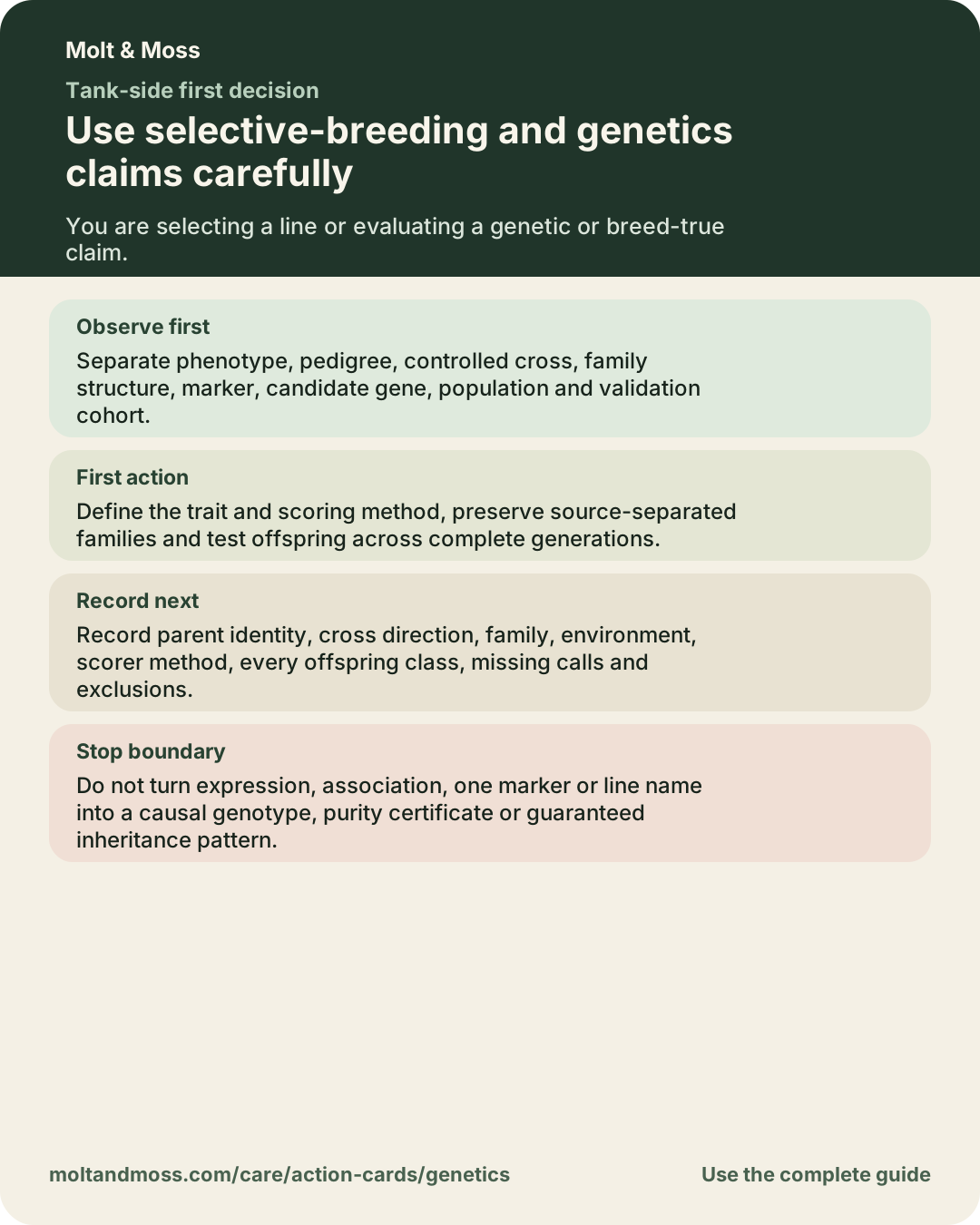
- genetics decision card Tank-side decision card
The card translates this guide into an observation, first action, next record and stopping boundary, so all four require editorial review when the source changes. - growth decision card Tank-side decision card
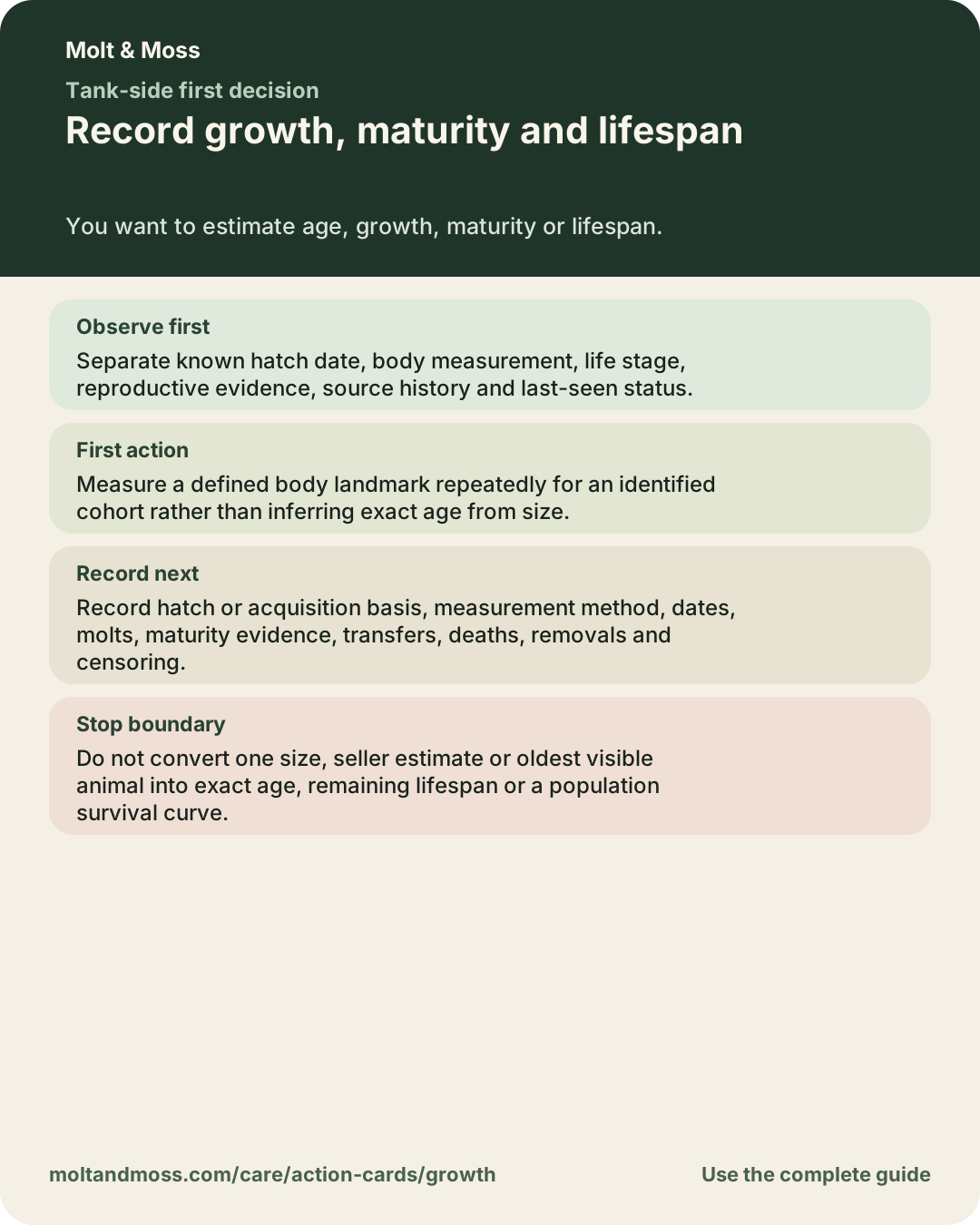
The card translates this guide into an observation, first action, next record and stopping boundary, so all four require editorial review when the source changes. - genetics practical guide Practical guide
The guide uses this evidence record and its practical wording must remain inside the revised source boundary. - growth practical guide Practical guide
The guide uses this evidence record and its practical wording must remain inside the revised source boundary. - aquarium-lifespan knowledge gap Canonical knowledge gap
The current knowledge-gap boundary depends on a dated search that used this exact source and must be reconsidered if the source meaning changes. - aquarium-lifespan answerability brief Answerability brief
The decision, endpoint, minimum design or closure rule may change when evidence used in the linked gap search is corrected. - aquarium-lifespan research allocation Current research allocation
The current allocation, activation trigger, next permitted unit or stop decision may change when evidence used in the linked gap search is corrected.
Generated from governing registry (13)
This surface derives from a governing registry and should update with it, but release tests must still prove parity and routing.
- Record CSL-JSON citation Citation export
The record citation export derives its note and source metadata from the evidence registry. - Record RIS citation Citation export
The record citation export derives its note and source metadata from the evidence registry. - Complete CSL-JSON bibliography Citation export
The complete citation export includes every evidence registry record. - Complete RIS bibliography Citation export
The complete citation export includes every evidence registry record. - genetics portable decision card Generated decision-card text
The portable text derives from the curated decision-card registry and must preserve every card section and both permanent links. - growth portable decision card Generated decision-card text
The portable text derives from the curated decision-card registry and must preserve every card section and both permanent links. - genetics complete visual decision card Generated decision-card visual
The typography-only visual and exact accessibility description derive from the curated decision-card registry and must preserve every card section. - growth complete visual decision card Generated decision-card visual
The typography-only visual and exact accessibility description derive from the curated decision-card registry and must preserve every card section. - Ageing the unageable: investigating novel methods of ageing crustaceans Canonical evidence page
The canonical evidence page derives from the current evidence registry record. - genetics evidence dossier Generated guide dossier
The dossier derives its linked evidence set from the record care path. - growth evidence dossier Generated guide dossier
The dossier derives its linked evidence set from the record care path. - Machine-readable knowledge export Machine-readable knowledge export
The versioned export includes the complete evidence registry and source-integrity audit. - Research map record Research map
The research map derives its source boundary from the evidence registry.
Historical record needs follow-up decision (2)
Do not silently rewrite history. Decide whether the prior change record remains accurate and publish a new correction or scope note when needed.
- Has a replicated known-hatch Neocaridina cohort been followed through individual deaths in home-like aquaria? Dated literature search
The dated search used this exact source as a candidate (included: Ageing the unageable: investigating novel methods of ageing crustaceans). Preserve the search history and decide whether a revised or additional search is required. - Failed molecular clocks do not create a shrimp age test Historical research change
The historical change cites this source. Preserve the old decision and decide whether a new public correction is required.
How this record is classified
System observation or method study: An aquarium, analytical or biological system was observed without an assigned Neocaridina animal treatment. The species relationship still identifies whether the evidence is biological or system-adjacent.
Direct Neocaridina evidence: The source measured animals named within Neocaridina. Direct still does not mean universal or sufficient.
Topics: Growth and lifespan, Genetics
Critically appraise this source without a score
These questions fit this record's system observation or method study role. They are prompts, not automatic judgments. Open the original source to answer them.
- Identity and provenance: How were the organism, population, stock and life stage identified and sourced? A published name or seller label can hide a taxonomic, population or life-stage transfer.
- Independent unit: What unit was independently assigned or sampled, and how many units support each comparison? Animal counts do not create independent replication when animals share a vessel, site, family or treatment history.
- Comparison and context: What was the actual comparator, allocation process, environment, duration and material condition? A result has meaning only against the comparison and conditions that produced it.
- Endpoint and measurement: Which endpoint was measured, with what method, unit, timing, resolution and decision rule? One endpoint cannot silently become survival, welfare, diagnosis, reproduction or long-term population performance.
- Denominators and missingness: Are starting counts, exclusions, losses, missing observations and analysis denominators reconciled? Unreported or changing denominators can alter the apparent direction, precision and applicability of a result.
- Transfer boundary: What is the nearest tempting aquarium claim that this source design cannot establish? Direct evidence can still be narrow, and adjacent evidence can be useful only while the inference remains visible.
- System relationship: Was the measured unit an aquarium system, analytical method, another taxon or another biological level? A system or method result is not automatically a Neocaridina animal response.
- Inference mechanism: What explicit mechanism or shared property makes the adjacent evidence relevant? Similarity must be stated and tested rather than assumed from a broad label.
- Target validation: Has the method or inference been validated in Neocaridina, the intended water, life stage and decision range? Analytical validity in one matrix or biological validity in another species may not transfer.
- Permitted use: Is the source being used only for its method or system role rather than promoted to animal evidence? Useful adjacent evidence becomes misleading when its role is silently upgraded.
Where it is used
Reuse the reviewed citation boundary
Download CSL-JSON or download RIS. Both retain this record's support, limitation and review note.
Challenge a transcription, interpretation or missing boundary. A challenge changes the record only after editorial review.